How to Make the Water Clear in an Aquarium How to Make Dirty Water Clean Again
What To Do With Muddy Water?

Water is important for all life forms on planet Globe. Water is in our bodies, and is used in every part of our lives. But water tin also contain contaminants that make information technology non-drinkable, non salubrious for us to potable. Contaminants can be:
Physical: particles of soil or organic affair from soil erosion
Chemical: elements or compounds that are natural or human-made, such as pesticides, bleach, nitrogen, man and/or animal drugs, metals, or toxins produced by bacteria. Some chemic contaminants (such as cesium, plutonium and uranium) are also dangerous because they can emit radiation.
Biological (or Microbial): organisms that live in water, such as leaner, viruses, protozoan, and parasites
Not-drink water is as well called grey water. So how practice we remove contaminants from grey water to make it potable, or safe to drink?
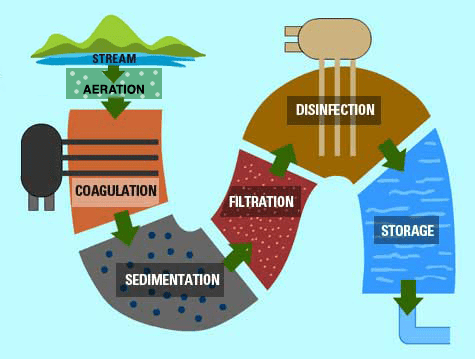
Source: http://www.eschooltoday.com/global-water-scarcity/how-water-is-treated-for-drinking.html
This graphic shows a bones water treatment process for surface water. The h2o from a stream enters the Water Handling Eye and goes through the following processes:
Aeration: Often the first process at a Water Handling Center, the water is brought into close contact with air. This removes dissolved gases, oxidizes dissolved metals (which makes them fall out of solution and become particles), and volatile organic compounds (VOCs).
Coagulation: Alum and other chemicals are added to the water. This causes particles to chemically stick together into floc.
Sedimentation: When the particles of floc go big enough, gravity causes them to sink to the lesser.
Filtration: The process of removing remaining pocket-size impurities.
Disinfection: Chlorine or other kinds of disinfection methods are applied to kill whatsoever bacteria and other living organisms that may be in the water.
Storage: H2o is stored in tanks while the process of disinfection completes, so is transported through pipes to our homes and workplaces
For more information about Wastewater Handling Processes:
Treating Muddy Water
CAUTION: In this experiment we will process "dirty water" using techniques that are used in water handling facilities. Although experiment illustrates how water is cleaned, the water processed will non be cleaned to the extent of existence beverage. FOR YOUR SAFETY, Practise NOT Drink Whatsoever Water Candy IN THIS EXPERIMENT.
Materials
For Safety and Tidiness
- Safety glasses
- Cover for habiliment (former shirt, apron, or smock)
- Tabular array cover
- Paper towels
To Make "Greyness Water" (Not-Potable Water)
- Liter- or quart-sized container with a lid (an empty 2-liter bottle works well)
- Two large cups (to cascade liquid back and along)
- Salad dressing (Italian works well, due to oiliness and suspended organic particles)
- Clay (a handful or and so)
- 1 L (approximately) Tap Water
- Liter- or quart-sized container with a lid (an empty 2-Fifty bottle works well)
- 2 large cups (to pour liquid back and along)
- one C (judge) Salad dressing (Italian works well, due to oiliness and suspended organic particles)
For Water Treatment Processes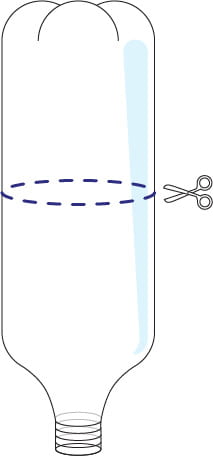
- 1 plastic ii-L canteen (cut with scissors into two parts:
- 1 Tbsp of alum (found in the spice or canning department of the supermarket)
- Stirring spoon
- Articulate Tupperware container or big cup (to filter into)
- ii rubber bands
- 2–5 coffee filters
- Variety of materials to use as filter media (eastward.k., cotton wool assurance, aquarium gravel, play sand, activated carbon, pebbles, marbles, etc.)
- Clean tap water (a bullpen works well)
- 2 litmus color strips and a pH color nautical chart (optional)
- Digital multimeter (optional)
Instructions
- Make the Grey Water: Mix a liter or so of water with a cup of salad dressing and a handful or so of dirt and place in the container with a cap.
Aeration
- Cap the container and milk shake the bottle to aerate the contents for a minute or two.
- Pour the dirty water into the commencement large cup and then pour it from one big cup to the other to further aerate it.
Coagulation
- Pour the aerated muddied water into the bottom half of the 2-liter bottle that has been cut in half.
- Add together i Tbsp Alum to the aerated dirty water.
- Slowly stir the mixture for 5 minutes. You will begin to run into particles forming in the liquid; this is the floc.
Sedimentation
- Allow the dingy h2o to stand untouched for 20 minutes. The particles volition sink to the bottom of the container. Meanwhile, make your filter for the next pace.
Filtration
- Making your filter:
- Identify ane or two coffee filters (depending on how strong/likely to rip they seem) over the mouth of the peak one-half of the ii-liter bottle that was cut in one-half. Make certain the coffee filters cover the whole opening (the smaller end where the cap would get; you lot don't need the cap) and secure them with the safety bands.
- Use your materials to pattern your filter. You volition desire to accept three distinct layers for the muddy water to pass through. Depending on what materials you accept, recall about what might be the best combination and best guild to layer materials in order to remove the well-nigh impurities. You lot can plan your filter using this diagram:
![Diagram of top half of two-liter soda bottle, with the large opening on the top and the mouth of the bottle on the bottom. The mouth of the bottle has a coffee filter secured to it with a rubber band, blocking the opening completely. Three layers are demarcated for labeling to indicate which material is planned for which layer of the filter.]](https://sites.udel.edu/k12engineering/files/2020/05/filterlevels.jpg)
- Identify your filter in the container into which you lot will be filtering. Arrange your layers of material. Without agonizing the top layer, pour clean tap water through your filter. After the filtered h2o collects in the filtering container, record your observations on the Filtration Experiment Information Sheet.
Yous tin write down your observations nigh the odor and advent of the filtered clean water in the boxes. If you have litmus paper and/or a multimeter, you can record the pH and electric electrical conductivity of the filtered make clean h2o besides. Gently move your filter and go along it upright when you empty your filtering container, then as not to disturb the layers of filtering fabric, after you lot take finished making and recording observations. - Leaving the sediment that has separated from the dirty water at the bottom of the container, pour as much of the muddied water into a new container (one of the big cups used in the aeration pace, rinsed, would be fine).
Write downward your observations nigh the odor and appearance of the muddied water in the boxes on the Filtration Experiment Information Sheet. If you have litmus paper and/or a multimeter, you can record the pH and electrical conductivity of the dirty h2o besides. - Place your filter back into the container into which y'all will exist filtering. Without disturbing the top layer, pour the dirty water through your filter. Later on the filtered water collects in the filtering container, record your observations on the Filtration Experiment Data Sheet.
Gently motion your filter and continue it upright when you pour the contents of the filtering container into another container (one of the large cups used in the aeration step, rinsed, would be fine), after you lot accept finished making and recording observations. - Identify your filter dorsum into the container into which you will be filtering. Without agonizing the pinnacle layer, pour the once-filtered dirty water through your filter. Later on the twice-filtered water collects in the filtering container, record your observations on the Filtration Experiment Data Sheet.
- Review your observations and consider the follow-upwards questions on the Filtration Experiment Information Sheet.
UD Connection
Applied science students at the University of Delaware'southward affiliate of Engineers without Borders (EWB) have worked with communities all over the earth to improve their drinking water. Using the skills they have learned in classes and on-site training, UD EWB has built filters and pumps for water in Republic of malaŵi and the Philippines. This is just one example of how engineers use science to solve problems.
©2020 UD Thousand-12 Engineering

ouellettesoned1956.blogspot.com
Source: https://sites.udel.edu/k12engineering/activities/what-to-do-with-dirty-water/
0 Response to "How to Make the Water Clear in an Aquarium How to Make Dirty Water Clean Again"
Post a Comment