Slack channel at Temple helps fight food waste and feed students in need
Feb. 10, 2020


News of free food spreads like wildfire on whatsoever college campus—peculiarly with the help of technology.
At the end of Temple's 2022 autumn semester, Kim Celano and Phillip Smith were together at the Division of Student Diplomacy staff celebration. Information technology was a catered party, and—as often is the case— there were lots of leftovers.
 "It was good food," remembers Celano. "There were almost fourscore sandwiches on one tray lonely; meat and cheese and fruit."
From the many other campus events they'd attended and hosted, they knew it was destined for the trash.
Smith pulled out his phone, started a group in the messaging app GroupMe, and posted photos of the food. He included the location and a caption: all this food is free; tell your friends. "In ten minutes we had students lining up out the door," Smith says.
Inside a couple days, the chat group was almost full (the app caps at 500) and students and faculty followed Smith's unproblematic format to spread the word about free nutrient opportunities across campus including leftovers, open events with gratuitous food, and random giveaways.
 Celano and Smith had implemented a elementary solution to ii issues they dealt with regularly.
Celano, the associate director of student operations in the pupil centre, works in facilities backside the scenes, prepping rooms for the jam-packed schedule of meetings and presentations.
Afterward events, they throw out a lot of food, Celano says. "Nosotros have an hour to turn over the room and nosotros didn't have a mechanism to put this nutrient anywhere that people would find it."
Similar post-issue waste happens all over campus.
Now, instead of dumping trays of leftovers directly into the trash, her squad can snap a couple photos, note the location and time the food is available until, and put out containers—students come to fill up a plate or take nutrient abode.
 They haven't attempted to track the numbers, but Celano estimates they've kept hundreds of pounds of food from being thrown away. Which, of form, is not just detrimental in terms of the wasted resources that went into growing, transporting and preparing the food; it's also environmentally costly in the landfill, releasing methane as it breaks down.
For Smith, director of educatee activities, it was campus hunger that sparked the idea for the grouping. "Food insecurity was a huge platform for final twelvemonth'due south student assistants," he said.
After the Hope Center for College, Customs and Justice released their report Alleviating Poverty and Promoting College Attainment in Philadelphia in the autumn of 2018, campus was hit with a staggering statistic: 35 percent of Temple's undergraduate students are food insecure.
It's in line with national averages for public institutions—at that place's a growing number of hungry college students across the land.
Food can be prohibitively expensive on campuses; at Temple, the price of an average repast is $vii.l (it's $5.20 if yous purchase a 25-meal-per-calendar week plan and $9 if you purchase a 10-meal-per-week program). And that's not necessarily considering dining services providers are gouging students—it'due south far more complicated than that, explains the Hope Center's founding managing director, Sara Goldrick-Rab.
"Temple has faced major country upkeep cuts," Goldrick-Rab says. "They have revenue needs, especially to keep up with the things students demand. It is very mutual for public universities who are faced with budgetary pressures to turn to nutrient and housing as a way to make money." Plus, it'south hard to offering the incredible choice students demand at an affordable price point.
All of which puts campus meals at a premium that many students tin can't afford.
Students from low-income homes who might take received complimentary luncheon in high school don't receive those aforementioned benefits when they reach higher. And though some authorize for SNAP, many don't know they qualify or how to sign up. And those that do tin't utilize their benefits at Temple'southward dining halls.
Without financial support from family members or federal programs, thousands of Temple students go without nutrient.
Smith can place with these students. "My mother had a brain aneurysm when I was xiv, so I kind of raised myself," he says. "I was a college athlete and was not able to work [because of NCAA rules]. If I missed the resident'due south hall because of practise, then there was no food. I couldn't call mom or dad to say hey, tin y'all ship me $fifty, 100? There were a lot of times that I went hungry at night."
In its first year, Celano administered an anonymous survey to find out how students were using the group. Of the twoscore who responded, 33 percent said they were using information technology primarily to post virtually free food; 46 percent to find out nearly free food as a perk; and 21 percent that identify equally food insecure.
As one student said in response to the question, How has the Free Food at Temple GroupMe impacted you?:
Before the existence of the GroupMe, there were days when I would go without eating whatever food. I normalized the practice of beingness hungry because I idea it was better to be financially stable than to be full but unsure of how I was going to brand rent… At that place accept been more than times than I can count where I was able to detect a meal in a time when I was uncertain where i would come up from, all because of the chat. I've been able to focus on my studies without having to root through trash or enquire friends for back up to observe food.
"Nosotros knew [hunger] was out there, simply it really humanized it to hear these personal accounts of the impact of this simple thing that we thought of," says Celano.
This type of food recovery solution is implemented in dissimilar forms on many campuses throughout the country. There's the national Food Recovery Network, which has 230 chapters across the U.S.; the Share Meals app started in 2022 at NYU; Sharing Excess, which was founded just beyond the river at Drexel, and many more.
And in that location are other anti-hunger initiatives at Temple, besides. The Academy's Intendance team works to connect students with food resources, including data about applying for SNAP benefits.
At Cherry Pantry, which opened in the winter of 2018, students tin get groceries and hygiene products once a week—and they don't have to fill out paperwork or prove their "eligibility."
Senior AaronRey Ebreo launched Swipes for Philadelphia; a local chapter of the national initiative Swipe Out Hunger that works to donate students' unused meal swipes to students in demand.
This can exist a tricky arrangement to work out, every bit those unused meals are already factored into the nutrient service turn a profit margin, but Ebreo, who was appointed Temple educatee government'due south director of basic needs terminal year, helped push Aramark Dining Services to donate i,000 meals as a pilot.
He hopes that later seeing the need (later on an overwhelming response to the program, the Intendance team implemented a demand-based application process and allocates v meals per educatee) they'll run a direct donation program similar to ones on other campuses.
 Celano and Smith's project is a small, grassroots endeavor, but one specially passionate student helped it grow since its launch is 2018.
Alexis Culp is a masters student at Temple'due south College of Education and the volunteer coordinator of Cherry-red Pantry. She heard well-nigh the gratis food grouping from a friend when there was however room to join, but she wasn't happy near the 500-member cap. "It doesn't brand sense to take a free food group that has a student limit," she says.
And then she helped Celano and Smith observe a dissimilar platform to use; they landed on Slack, which has no cap. It has a few other benefits, too: Slack allows side conversations about a specific post without crowding the main aqueduct, and students don't have to login with any identifying information.
"It helped remove that barrier for students who do identify as nutrient insecure and experience the stigma of it," Celano says.
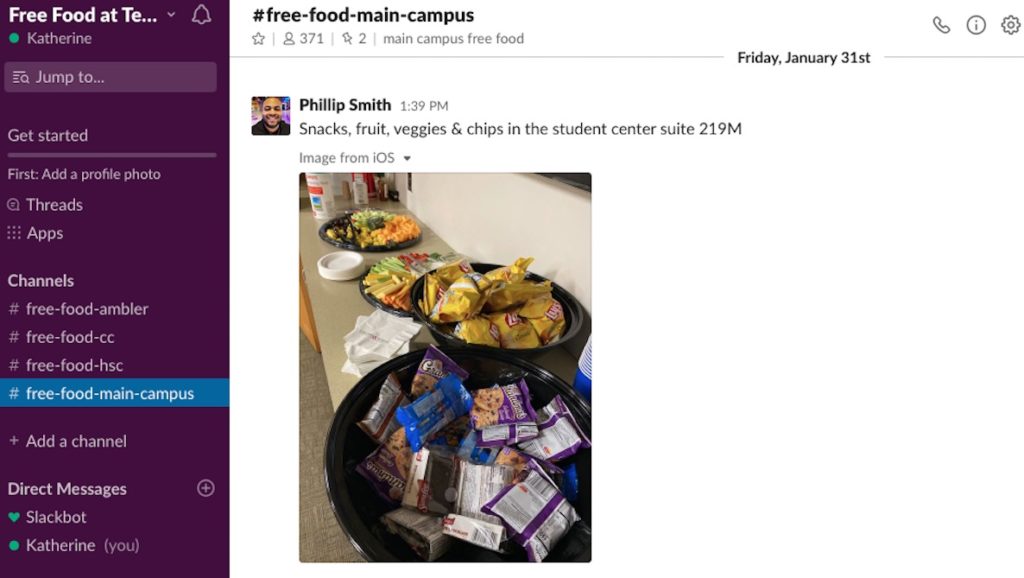
Since they switched over to Slack concluding autumn, they're building upward their audition again; afterward weeding out last years' graduates, they have more than 360 members.
They're standing to spread the word to student organisation leaders, department heads, and faculty across campus, and Culp created channels for the Health Sciences Center, Ambler and Center City campuses, too.
"[Hunger on campus] is a lot more prevalent than you think," says Culp, who sees 150 to 200 students come through Cherry Pantry each week. "I never knew there were other students who grew up on nutrient stamps, like me; who went to pantries, like me; that food insecurity followed them to college, like me."
Culp received financial assistance ("Which just comes in the class of loans," she points out) to assist cover the price of tuition when she started college at Temple in 2016. But she was on her ain for other expenses like books and supplies, housing, and her repast plan—all of which tin add up to more than half the total cost of attending college.
At the get-go of her freshman year, she purchased a 10-meal-per-calendar week program, the minimum requirement for students living on campus. The programme costs $one,453—about $9 per repast. And you tin merely swipe into the dining hall to consume 10 times per calendar week. By the weekend, Culp would only have two meals left, she says.
"On Saturdays and Sundays, I would swipe into the dining hall at 9am for breakfast and I would stay the whole mean solar day," she says. In that location were other students in the same state of affairs—they'd bring their computers to do homework and a coating and stay through dinnertime. "I was food insecure, according to my own definition. Yous don't know when your next meal is going to come to yous, and yous have very limited access to nutritious meals."
As a freshman, Culp was among the roughly ten,000 students who make upwards that 35 percent of food insecure students on Temple'south campus whose stories and experiences are varied.
Some live on campus with a limited repast program, like Culp; others alive off campus and melt for themselves; and some don't accept reliable housing at all—all struggle to afford consistent, nutritious meals.
And, of class, when that basic need is not met, it'southward hard to focus on classes, which means students aren't as likely to graduate. According to the Promise Center's written report, food and housing instability are key drivers of college dropout rates.
 It'south the same story at public universities beyond the country, merely as the poorest big city, it hits Philadelphia especially hard.
"Families across the city suffer if the students they have paid tax dollars to brainwash Thou-12 become out, go to college and then drop out," Goldrick-Rab says. "Nosotros're not going to attract employers, we're not going to increase the number of good paying jobs—we're going to have tons and tons of people who need our government services over and over throughout their lives, nosotros're too going to take a real wellness problem in the metropolis."
Goldrick-Rab advocates for larger, systemic changes: creating a better dining service business model that decreases the cost of food on campus; implementing more innovative ways to deploy emergency assistance; and adopting policies like the Hunger Free Campus Deed introduced by Rep. Malcolm Kenyatta concluding month.
Grassroots efforts like the Slack group—led past passionate students and faculty—are a meantime solution that show at that place's something everyone can exercise.
Want more? Check out these related pieces:
- City composting pilot to make good employ of Philadelphians' nutrient waste material
- Challah For Hunger takes on nutrient insecurity in Philadelphia and across
- Campus Thrift Stores help fight waste matter. We should bring them to Philly
- Anonymous nutrient pantries help finish the stigma of seeking free food

ouellettesoned1956.blogspot.com
Source: https://thephiladelphiacitizen.org/temple-slack-channel-fights-campus-hunger/
0 Response to "Slack channel at Temple helps fight food waste and feed students in need"
Post a Comment